
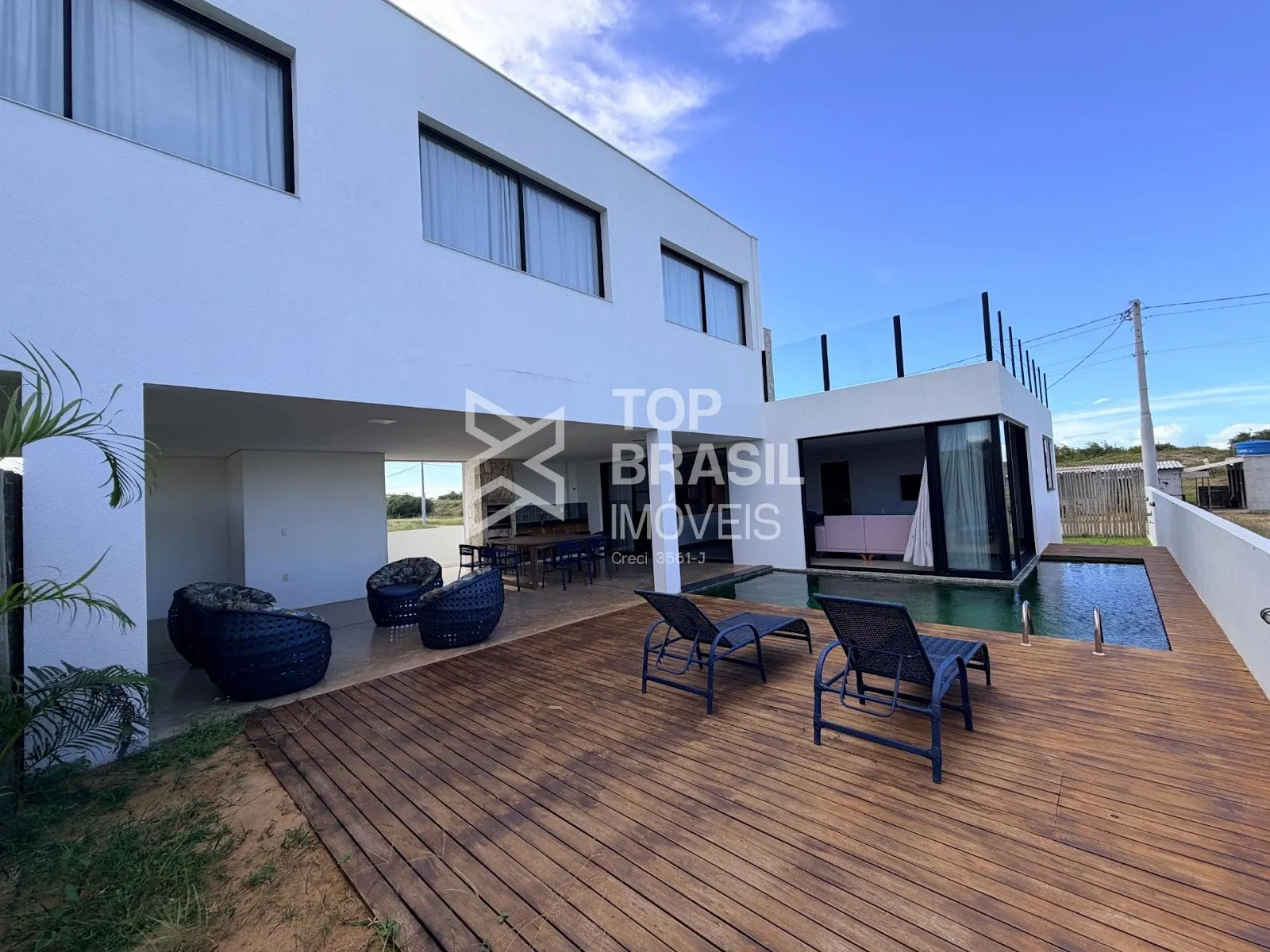
Beach house design in Northeast Brazil: wind, sun and salt
By André Barros, licensed broker (CRECI-RN 6631) · Updated November 8, 2026Photo: Top Brasil ImóveisWhy does Gostoso need a different kind of house?
São Miguel do Gostoso is a wind town. IKSURFMAG reports 20 to 25 knots from September to February, on 90% to 100% of days. That wind brought kitesurfing and the people who now buy homes here. It also defeats houses designed for a colder, calmer climate.
A closed box with small windows and air conditioning in every room fights the climate. A house opened to the wrong side becomes a sand tunnel. The best local projects use the breeze as free cooling and shelter from it where needed.
What do Brazilian building codes recommend for this climate?
ABNT NBR 15220-3 splits Brazil into eight bioclimatic zones. Natal, 100 km (62 miles) from Gostoso, is in zone 8, the hottest and most humid. For it, the standard recommends large shaded openings, light and reflective walls and roofs, and permanent cross ventilation.
| Decision | What to do | Why |
|---|---|---|
| Ventilation | Windows on opposite walls, tall doors, louvered shutters | NBR 15220-3 recommends permanent cross ventilation in zone 8 |
| Openings | Large, shaded by eaves, porches or brise-soleil | Let air in without letting the sun heat the room |
| Roof | Light-colored tiles, ventilated ceiling, deep eaves | Light, reflective roofs are a zone 8 guideline |
| Concrete by the sea | Exposure class III (marine) or IV (tidal splash) | NBR 6118 requires more cover and stronger concrete in these classes |
| Metals | Marine-grade stainless steel, coated aluminum | Salt air corrodes plain steel quickly |
Sources: ABNT NBR 15220-3:2005 and ABNT NBR 6118 exposure classes (summarized by Sienge). Your architect and structural engineer are responsible for the actual design.
Which way should the house face?
Prevailing winds in Natal come from the northeast, east and southeast, according to a wind study presented at ENTAC, the Brazilian building technology conference. Gostoso reads the same way: windows facing the eastern quadrant get a breeze all year.
The sun asks for the opposite. Near the equator the sun runs high, and the walls that heat up most face west in late afternoon. Good local architects open the house to the wind, shield the sunset side and use the laundry, garage and bathrooms as a thermal buffer on the west. The sunset deck still happens, under a deep roof.
How do you build so salt air does not eat the house?
Salt gets into concrete and reaches the steel. NBR 6118 handles this through exposure classes: class III is marine, class IV is the tidal splash zone. The higher the class, the thicker the concrete cover and the stricter the mix. Ask your engineer which class they used. If the answer is urban for a house 50 m from the beach, something is wrong.
Outside the structure, material choices decide your yearly repair bill. Aluminum frames with coastal coating, marine-grade stainless hardware, corrosion-resistant outdoor lights and air-conditioning condensers with anti-corrosion protection last far longer. Plain painted steel is what I see rusting on new beach houses.
Pools, decks and gardens in strong wind
An exposed pool cools down, loses water and collects sand in the wind season. Projects that work in Gostoso put the pool on the sheltered side or behind a low wall or planting. Native coastal plants and coconut palms handle salt and wind without daily watering. For rentals, an outdoor shower and a place to store boards and kites matter more than a showcase lawn.
Designing for rentals, a second home or full-time living
For vacation rentals, en-suite bedrooms, a good kitchen and covered outdoor space are what guests look for. AirROI data show 4-bedroom houses in Gostoso earning about R$ 67,000 a year (about US$ 12,400) at 25% occupancy from November 2025 to October 2026. A well-ventilated house also lowers the power bill, which comes out of that revenue.
A second home has to survive being closed for weeks: shutters that ventilate while locked, metals that do not rust, little that needs weekly care. For full-time living, add a home office facing the breeze. In every case the right plot comes first, because orientation, size and community rules shape the whole design.
How I help before you hire an architect
When you ask me for a plot, I already check which way it faces, where the wind hits, what the community allows you to build and whether the title allows financing. I also have finished high-end homes so you can compare building with buying.
Selected for you
Lot of 416 m² at Condomínio Uhane Luxury Villas, São Miguel do Gostoso
416 m² lotR$ 490,000Approx. US$ 85,000 · € 78,000Lot 103 at Condomínio Uhane Luxury Villas, São Miguel do Gostoso
416.25 m² lotR$ 480,000Approx. US$ 84,000 · € 76,000Beachfront lot at Dune Beach & Ville, Praia do Dune, Gostoso
377.65 m² (4,065 sq ft)R$ 415,000Approx. US$ 72,000 · € 66,0004-bedroom house with ocean-view rooftop at Condomínio Uhane
280.13 m² (3,015 sq ft)R$ 2,300,000Approx. US$ 401,000 · € 364,000Keep reading
Frequently asked questions
What bioclimatic zone is Natal in?
Zone 8 of ABNT NBR 15220-3, which recommends permanent cross ventilation, large shaded openings and light, reflective roofs.
Which way should a beach house face in Northeast Brazil?
Open the main rooms to the prevailing northeast, east and southeast winds and protect the west side from the afternoon sun.
What concrete class is required near the sea in Brazil?
Under NBR 6118, class III covers marine environments and class IV the tidal splash zone, with more rebar cover and stronger concrete. The engineer sets it.
Which materials resist salt air best?
Marine-grade stainless steel, aluminum with coastal coating and suitable treated wood. Plain painted steel rusts quickly.
Where should the pool go in a windy beach town?
On the side sheltered by the house, a low wall or planting.
Send me a WhatsApp message and I'll send you the plots with the orientation of each one, ready for your architect.
Message André on WhatsApp
Sources
- ABNT NBR 15220-3:2005, Brazilian bioclimatic zoning (USP copy, in Portuguese)
- Sienge: chloride attack and the exposure classes of NBR 6118 (in Portuguese)
- ENTAC/ANTAC: study of wind patterns in Natal, Salvador and Maceió (in Portuguese)
- IKSURFMAG: São Miguel do Gostoso kitesurf travel guide
- AirROI: Airbnb data for São Miguel do Gostoso (Nov 2025 to Oct 2026)
- Central Bank of Brazil: PTAX exchange rates
- Top Brasil Imóveis: listings by André Barros in São Miguel do Gostoso (checked Nov 8, 2026)
This guide is general information, not legal or tax advice. Before buying, have the documents reviewed by an independent Brazilian lawyer.